Meme Coin Trading, Lessons From a Pro Challenge
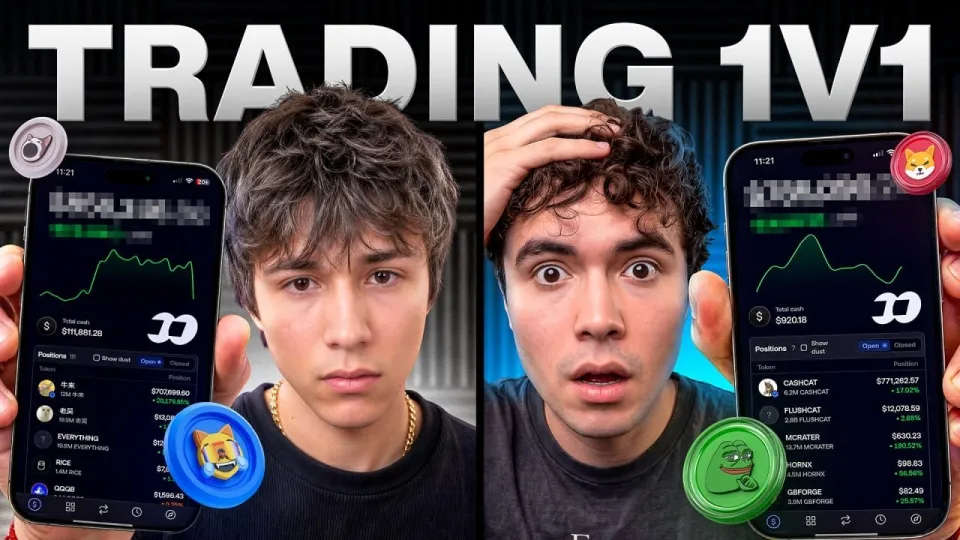
Video: I Challenged A Pro Memecoin Trader (Who Won?)
Want articles like this for your own video to promote it on YouTube and Google? Order them through the Telegram bot @sat_sit_bot. The bot writes and publishes the articles itself (with your YouTube video embedded) on popular topical websites (no ads). Try it free: 50 articles on us.
Key takeaways
- The insentos challenge video from August 25, 2026 pairs the host with a guest trader across roughly 37 minutes of live memecoin trading before a shorter session with Grand.
- Two tools dominate the workflow in the description: fomo.family for the trading community and axiom.trade as the execution terminal.
- Viewers repeatedly ask for a 50-to-1000 challenge, showing demand for small-bankroll, rules-based memecoin experiments.
- The most-liked comment praises the guest for explaining his thought process mid-trade, which is the core skill the format teaches.
- Several comments note that most similar videos end in losses, framing memecoin trading as closer to gambling than investing without strict risk limits.
Meme coin trading is short-horizon speculation on tokens with no cash flows, no earnings and no fundamental valuation, where profit comes from reading liquidity, momentum and crowd behavior rather than from holding a business. The insentos challenge video, published on August 25, 2026, puts that idea on screen: the host and a guest trader trade live, explain their reasoning out loud and compare results in a format closer to a coaching session than a highlight reel. If you want to follow the same setup, the entry point used in the video is the fomo.family registration link.
What the insentos meme coin challenge actually tests
The challenge format tests decision quality under time pressure, not luck on a single token. Two traders sit in a live call, scan Solana memecoins, size positions and talk through entries while the audience watches the screen. The video runs about 37 minutes of trading and commentary, then a shorter block with Grand at roughly the 37-minute mark before the outro. The value is in the narration: you hear why a chart looks interesting, where the invalidation sits and when the trader walks away.
A guest who keeps explaining his process while managing a live position is doing the hardest part of the job. Most beginners can describe a setup after the fact; very few can articulate a thesis, a stop and an exit plan in the ten seconds a memecoin gives them. That gap is the real subject of the video.
The tool stack behind live memecoin trading
Execution speed and information flow decide outcomes in memecoin scalping, so the stack matters as much as the thesis. The video description points to two resources: fomo.family, a trading community accessed through https://fomo.family/r/insentos, and Axiom at https://axiom.trade/, a terminal built for fast on-chain trading on Solana. Axiom is the kind of interface that bundles charting, wallet connection, token safety checks and order routing in one screen, which is why memecoin traders gravitate to it over juggling five browser tabs.
A practical stack for a beginner looks like this:
- A Solana wallet funded with a small, disposable amount of SOL for fees and position size.
- A trading terminal such as Axiom for charts, liquidity data and execution.
- A community or alert source, like the one linked in the video, to surface candidates worth reviewing.
- A separate notes file where every trade is logged with entry, exit and the reason for both.
None of these tools create edge on their own. They shorten the distance between an idea and an order, which cuts both ways when the idea is bad.
Reading a memecoin before you buy
A memecoin candidate is judged on four things in the first minute: liquidity, holder distribution, contract safety and momentum. Liquidity tells you whether you can exit at all; a pool with a few thousand dollars will move violently against you on the way out. Holder distribution shows whether one wallet can dump the chart. Contract checks catch mint authority, freeze authority and honeypot patterns. Momentum tells you whether anyone else cares right now.
In practice, experienced traders run the same checklist every time so that adrenaline does not replace analysis:
- Liquidity above a threshold you set in advance, sized to your position.
- No single wallet holding a share large enough to crater the price.
- Renounced or burned mint authority, with trading enabled and sell taxes at zero.
- A chart structure with a defined level that invalidates your idea.
- A social or narrative reason the token exists today, not last month.
If any line fails, the trade does not happen. The discipline of skipping is what separates a scalper from a gambler, and it is the habit a live challenge makes visible.
Position sizing and exits in meme coin scalping
Risk control in memecoin trading means assuming every position can go to zero and sizing so that outcome is survivable. A common approach is to risk a fixed small percentage of the bankroll per trade, take partial profit at the first strong move and trail the rest. Because these tokens can halve in seconds, pre-committing to an exit removes the hesitation that costs the most money.
Three rules that hold up across strategies:
- Define the loss before entry, not after the chart turns red.
- Scale out in pieces so a single decision does not determine the whole result.
- Stop trading after a set number of losses in a session, because tilt compounds faster than any position.
The audience reaction to the video is telling: viewers ask for a 50-to-1000 challenge, a format that only works with strict per-trade risk, and others point out that similar videos usually end in losses. Both reactions describe the same reality, which is that the process has to survive a bad streak.
Common beginner questions about memecoins
Beginners usually ask the same handful of things, and the honest answers are less exciting than the marketing. The most frequent question is how much capital is needed; the answer is an amount you can lose entirely without changing your life, because the failure rate on new launches is high. The second is whether a community group guarantees results; it does not, it only shortens research time.
Another recurring theme is how much of the outcome is skill. A trader who narrates entries, defines invalidation and cuts losses is applying skill; a trader who buys because a chart went vertical is applying hope. The difference shows up over dozens of trades, not one. Finally, newcomers ask whether live trading videos are worth watching; they are, provided you watch the reasoning rather than copying the tickers, since the tickers are stale by the time you see them.
Picking up the right habits from the format
The strongest takeaway from a live challenge is a repeatable routine you can run alone. Watch how the traders filter candidates, how quickly they abandon a thesis that stops working and how they talk about size relative to conviction. Then build your own version: a watchlist process, a checklist, a fixed risk unit and a log. Review the log weekly and cut whatever does not work.
Treat every video trade as a case study, not a signal. The token names change daily; the reasoning patterns do not. That is why a session with an articulate guest is more useful than ten screenshots of wins.
Useful links
- fomo.family registration and community access: https://fomo.family/r/insentos
- Axiom trading terminal: https://axiom.trade/
- insentos on X: https://x.com/insentos
- insentos on Instagram: https://www.instagram.com/insentos
- insentos on TikTok: https://www.tiktok.com/@insentos
Final thoughts on the meme coin challenge
The insentos challenge works because it shows the unglamorous part of memecoin trading: hesitation, quick exits and trades that never happen. The guest's habit of explaining his thought process mid-trade is the most transferable lesson in the video, and the audience's request for a small-bankroll challenge confirms that risk control is what people actually want to learn. Use the format to study decisions, not to chase tickers, and start with a bankroll you can afford to lose. If you want the same community and tooling used in the session, begin with the fomo.family signup link and keep Axiom open for execution.
Questions & answers
How much money do I need to start meme coin trading?
Only an amount you can lose completely without affecting your finances, because a large share of new tokens fail. Treat the first bankroll as tuition for learning execution, risk sizing and exits rather than as capital you expect to grow. Increase size only after a documented stretch of disciplined trades.
Are trading communities and groups worth joining?
They shorten research time by surfacing candidates and sharing tooling, but they do not guarantee outcomes and cannot replace your own checklist. The useful part is the process other traders describe, including how they skip bad setups. Access itself is often the friction point, which is why the video links a specific entry route.
Why do so many live trading videos end in losses?
Memecoins are high-variance instruments where liquidity is thin and narratives rotate within hours, so even good traders have losing sessions. Videos that only show wins are edited, and honest live formats reveal the loss rate. Judge a trader by how losses are contained, not by whether a session ended green.
Is meme coin trading skill or gambling?
It sits on a spectrum, and the deciding factor is whether risk is defined before entry. Traders who size positions, set invalidation levels and stop after a losing streak are applying a process. Buying vertical charts with no exit plan is gambling with extra steps.
Source: I Challenged A Pro Memecoin Trader (Who Won?) · Markdown version